Power and Evaluation: Why Students Become Even Quieter Around Sensitive Topics
In my last post, I explored how the technological structure of Zoom produces silence through visibility, recording, and self-surveillance. But technology alone cannot explain why online classrooms feel so intellectually fragile. What makes silence even more powerful is the deeper structure layered on top of technology—the intersection of instructor authority, grading power, and identity. Together, these forces create an environment where speaking becomes a calculated risk rather than a normal part of learning.
Many people assume that students stay quiet because they lack confidence or motivation. I disagree. I think students are performing a highly rational form of risk assessment. And the biggest source of that risk is the fear of expressing sensitive or controversial ideas in front of someone who has the authority to evaluate us—and in a space where everything is recorded.
1. Identity and Authority: “Can I Say This?”
Consider an extreme but realistic example. If a professor is Israeli, can a student openly express a critical perspective on Israeli state policy? If a professor is Ukrainian, can a student raise a politically unpopular or nuanced view about the Russia–Ukraine war?
This is not about political correctness. It is about the structural tension created when power, identity, and evaluation intersect. Most professors are fair and professional. But students cannot be certain how their comments will be interpreted—especially when the topics are emotionally or politically charged. And in an online environment, every uncertainty becomes amplified:
- every spoken word is recorded
- chat logs are saved
- discussion posts persist indefinitely
- and all of it, potentially, could influence evaluation
Even if evaluation never becomes punitive, the simple fact that it could creates silence. In other words, students are placed in a structural position where they must consider the instructor’s identity and authority before speaking. This alone fundamentally reshapes what feels “safe” to say.
2. My Case: A Minority Who Still Cannot Speak Freely
I am an Asian minority student living in Canada(with a precarious legal status—holding no voting rights and constantly aware that my stay here is conditional). And yet, despite being part of a demographic often associated with DEI initiatives, I do not automatically support DEI or affirmative action. I believe these policies have merits, but I also think they have serious practical limitations and unintended consequences. However, expressing this perspective openly in a university setting is extremely difficult.
Why?
- DEI has become a moral standard on campus
- dissenting opinions can easily be interpreted as insensitive or harmful
- online criticism is permanently recorded
- and I have no certainty how an instructor or TA might interpret my intentions
This is where identity becomes a double-edged sword.
Paradoxically, my minority identity does not protect me—it makes the situation more complex. When a minority student voices a critique of DEI, the comment is no longer heard as “an opinion,” but as a political and moral stance that may clash with institutional expectations.
And this tension is not new. Even conservative Black Supreme Court Justice Clarence Thomas(front row, second from left) has written about this dilemma. He has openly acknowledged the discrimination and historical pain experienced by his own community, but nevertheless insisted that “the principles of the Declaration must be preserved — that all men are created equal, are equal citizens, and must be treated equally before the law.”(Students for Fair Admissions, Inc. v. President and Fellows of Harvard College, 2023, p. 58)
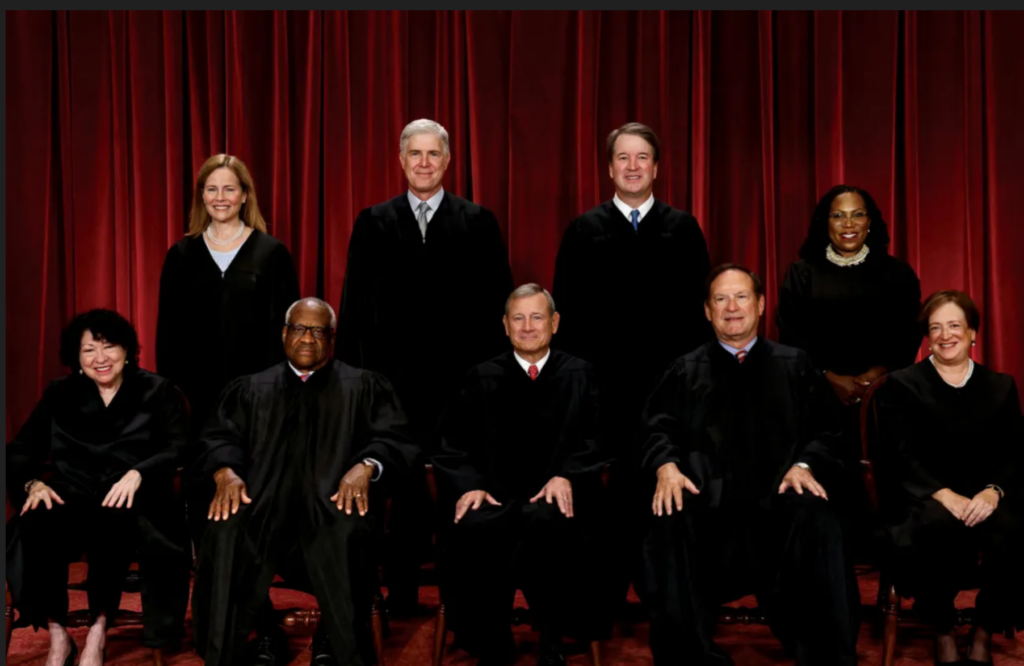
Figure 1. Official portrait of the U.S. Supreme Court Justices. Referenced in relation to the discussion on structural power and identity in evaluation.(Source: America Magazine)
His position illustrates something important: identity does not mechanically determine one’s beliefs. A person can recognize historical injustice and still hold a philosophical commitment to legal equality. Likewise, a minority student can question certain DEI practices without rejecting their identity or attacking others.
But in an online classroom—where every word is recorded, archived, and potentially tied to the person who grades you—expressing this kind of nuance feels dangerous. Before I can even articulate my thoughts, I find myself calculating the risks: How might this be interpreted? Will this be misunderstood? Could this affect my grade?
Faced with this, the choice becomes simple:
Speak, or stay silent to survive.
And silence is almost always the safer option—especially for an international student whose single misstep means an immediate, forced return home.
3. Why Online Environments Make This Even Worse
In a physical classroom, a professor might forget what a student said the next day. Online, nothing disappears.
- Zoom recordings
- Brightspace discussion threads
- chat transcripts
- email exchanges
- the digital footprint of every submission
Any of these could be referenced later—intentionally or unintentionally. If there is even a 1% chance that a controversial comment could affect evaluation, then the cost of speaking becomes too high. Thus, the more sensitive the topic, and the more it intersects with the instructor’s identity or perspective, the more likely students are to:
- withhold opinions
- soften their language
- avoid risk
- and ultimately engage in structural self-censorship
This is not individual anxiety. It is a predictable response to a system where authority, identity, evaluation, and permanent records converge.
4. The Dual Perspective: Professors Aren’t the “Villains”
It is important to emphasize the dual nature of the problem.
- Professors do not intend to silence students.
- They may not even realize their identity or authority shapes classroom dynamics.
- They may assume students’ silence reflects disengagement rather than structural risk avoidance.
The issue is not personal; it is structural.
The combination of:
- instructor grading power
- permanent recording
- sensitive political or identity-based topics
- the possibility of being misunderstood
- and institutional expectations around DEI
creates a tension that makes truly open discussion nearly impossible. No malicious intent is required for silence to emerge. The system itself generates it.
Conclusion: Silence Is a Rational Survival Strategy
Student silence is not laziness. It is not apathy. It is self-protection in a system where the risks of speaking outweigh the benefits.
- authority
- evaluation
- identity politics
- digital archives
- surveillance
These forces together form an environment where speech becomes dangerous and silence becomes rational.
Next Steps: The Paradox of Online Peer Interaction
In the next post, I will shift focus from instructor–student dynamics to student–student dynamics. Why do breakout rooms—spaces meant for collaboration—so often collapse into awkward silence? How do students monitor one another, and how does a collective “safe silence” emerge as a survival strategy? I want to explore whether online collaboration actually encourages speech—or whether it produces a new form of peer-based surveillance that reinforces silence even further.
📚 References
Students for Fair Admissions, Inc. v. President and Fellows of Harvard College. 600 US 181. Supreme Court of the US. 2023. Supreme Court of the United States, www.supremecourt.gov/opinions/22pdf/20-1199_hgdj.pdf.
