How does online course silence students?
For my free inquiry project, I want to explore a question that has been on my mind for a long time: “How do online classes make students silent?” Often, when students don’t participate, people think it’s just because they are shy or not motivated. But I believe it’s not so simple. I can’t help but wonder if it is the special structure of the online environment itself that is suppressing our voices.
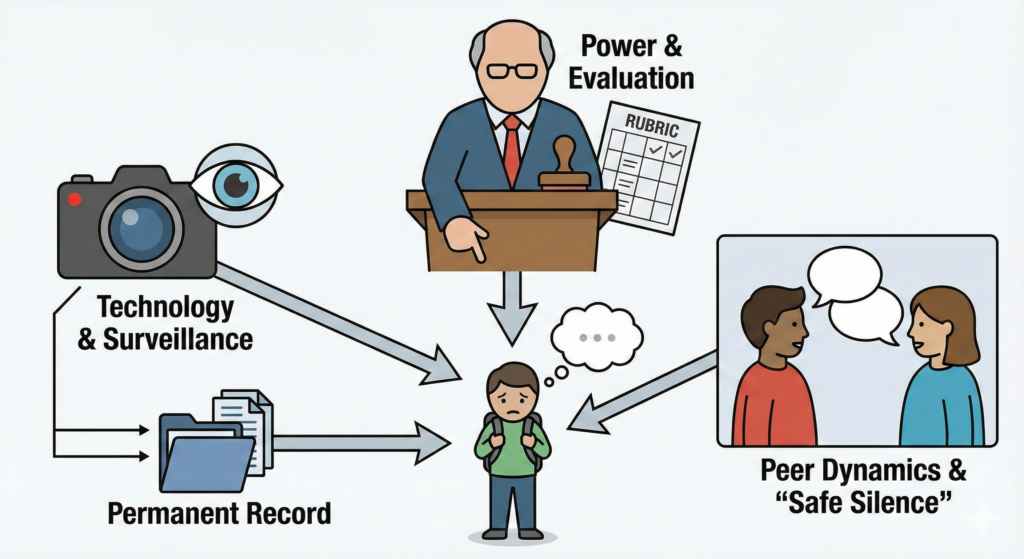
The way I see it, the silence in online classes might be a structural problem caused by the intersection of three invisible factors: power, technology, and evaluation. First, there is a fundamental power imbalance between professors and students. In a one-way lecture through a screen, the professor’s words can often feel like the only “correct answer.” In this situation, I feel that offering a different opinion or asking a critical question could lead to anxiety about it negatively affecting my grade. As a result, instead of taking an intellectual risk, I find myself choosing the safer path for my evaluation, and without realizing it, I just stay quiet.
I also think this anxiety is amplified by the technological features of the online classroom. An environment where lectures are recorded and every comment in the chat is saved as a permanent log makes me feel like I am under an invisible surveillance camera. The fact that all my words are saved as data and can be reviewed at any time seems to take away my freedom to be wrong or to express a different view—what I would call the “freedom to be wrong.” This can lead to a difficult cycle where, to avoid potential risks, the safest choice is to not speak at all.
This structural pressure feels even stronger, especially when we discuss sensitive topics like feminism or certain political issues. To publicly state an opinion that is different from the professor’s view or the general mood of the class can feel like more than just sharing a thought; it feels like putting myself on trial. So, while the online classroom looks like an open forum for discussion on the surface, I have to ask: has it actually become a space that forces us to self-censor and remain in a state of ‘safe silence’?
Future Inquiry Roadmap
To answer the question, “How does online course silence students?”, I have designed a learning plan to dissect this issue layer by layer over the next few weeks. My inquiry will move from the technological environment to the power dynamics, and finally to the peer interactions.
1. The Surveillance Classroom: How Technology Makes Us “Visible” Next, I will analyze how the specific features of online platforms (Zoom, Brightspace, recording logs) function as mechanisms of invisible surveillance. I plan to explore the concept of the “digital cost of speaking”—analyzing why the permanence of digital records makes speaking up feel like a high-risk activity rather than a learning opportunity.
2. Power and Evaluation: The Disappearance of the “Freedom to Be Wrong” Following the technological analysis, I will investigate the intersection of power and grading. I want to understand how the asynchronous structure and rubric-based evaluations reinforce the idea that “Professor’s word = Right Answer,” thereby shrinking the space for intellectual risk-taking. I will look for resources discussing how grading systems impact student anxiety in digital settings.
3. The Paradox of Online Discussion: When Silence Becomes Collaboration Finally, I will broaden my scope to the social dynamics among students. Why do breakout rooms often fall into awkward silence? I will examine how students monitor each other and how a collective “safe silence” is formed as a survival strategy in group settings. I aim to challenge the assumption that “Online Collaboration = Active Speaking.”
Methodology
For this inquiry, I will be curating academic articles related to digital privacy and educational psychology, reflecting on my own experiences in other online courses, and observing the dynamics in our current learning pod.
My peer’s blog
